
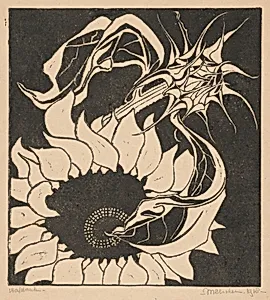
Sunflowers
1918
Medium
linoleum cut on light tan wove paper
Dimensions
plate: 16.5 x 15.1 cm (6 1/2 x 5 15/16 in.) sheet: 22.2 x 17.5 cm (8 3/4 x 6 7/8 in.)
Classification
Department
CG-E
Museum
National Gallery of Art, Washington, D.C.
Credit
Cornelius Van S. Roosevelt Collection
Accession Number
1983.109.100
Rights
Public Domain
Art Historical Context
**Sunflowers** is an early linoleum-cut print by Dutch artist M.C. Escher, created in 1918 when he was just twenty years old. Printed on light tan wove paper, the modest-sized work (plate roughly 6½ × 6 inches) belongs to the National Gallery of Art’s Cornelius Van S. Roosevelt Collection and offers a glimpse of the artist’s beginnings as a printmaker. Escher later became celebrated for mathematically precise tessellations, impossible architectures, and optical illusions. This youthful sunflower study, however, belongs to his student years in Haarlem, when he was still exploring traditional subjects and the graphic possibilities of relief printing. Linoleum cut—a technique using a soft linoleum block rather than wood—was then a relatively new, accessible medium that encouraged bold, simplified forms and strong contrasts. The print’s quiet botanical focus hints at Escher’s lifelong attention to natural pattern and structure, interests that would eventually transform into the dazzling, mind-bending worlds for which he is famous. As an early experiment in a technique he would continue to refine, *Sunflowers* reminds us that even the most visionary artists begin with close, patient looking.
About the Artist
M.C. Escher · 1898–1972
Maurits Cornelis Escher (1898-1972) was a Dutch graphic artist renowned for his mathematically-inspired woodcuts, lithographs, and mezzotints featuring impossible constructions, tessellations, and explorations of infinity. Though he considered himself lacking in mathematical ability, Escher's work demonstrates profound intuitive understanding of geometry, symmetry, and spatial paradox. A transform...