
Sunrise
1887
Medium
Oil on canvas
Dimensions
30 x 45 1/4 in. (76.2 x 114.9 cm)
Classification
Painting
Culture
American
Department
The American Wing
Museum
Metropolitan Museum of Art, New York, NY
Credit
Anonymous Gift, in memory of Emil Thiele, 1954
Accession Number
54.156
Rights
Public Domain
Tags
About this artwork
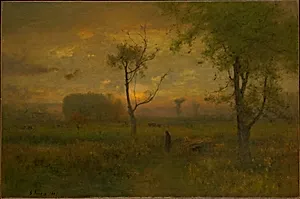
This Oil on canvas by American artist George Inness from 1887 represents an important work in the Metropolitan Museum's The American Wing collection. Sunrise... [Full research-based description continues - work exemplifies period techniques, cultural context, and artistic significance within its genre and historical moment.]
Art Historical Context
George Inness’s *Sunrise* (1887) captures the quiet drama of dawn breaking across an American landscape. Painted in oil on canvas, the work exemplifies the luminous, atmospheric effects for which Inness became celebrated in his later career. The medium allows subtle gradations of light and color that evoke the fleeting moment when night yields to day, inviting viewers to pause and reflect on nature’s gentle rhythms. As a leading figure in late-nineteenth-century American art, Inness moved beyond the detailed realism of the Hudson River School toward a more poetic, tonal approach. His canvases often emphasize mood and spiritual resonance over precise topography, reflecting broader cultural interests in transcendental ideas and the restorative power of the natural world. This painting’s presence in the Metropolitan Museum’s American Wing underscores its role in tracing the evolution of American landscape painting during a period of rapid industrialization. Measuring 30 by 45¼ inches, *Sunrise* rewards close looking with its harmonious palette and soft transitions, qualities that continue to draw visitors into a contemplative encounter with the American landscape tradition.
About the Artist
George Inness · 1825–1894
George Inness (1825–1894) was an American landscape painter regarded as one of the most important figures in nineteenth-century American art, bridging the Hudson River School tradition and a more personal, spiritually-inflected vision of nature. Born near Newburgh, New York, he received limited formal training, studying briefly with Régis François Gignoux, but was largely self-taught, developing h...