
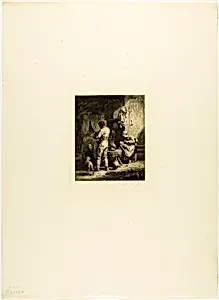
Supper
c. 1865
Medium
Etching, engraving and drypoint on ivory laid paper
Dimensions
Image: 13.3 × 10.9 cm (5 1/4 × 4 5/16 in.); Plate: 15.5 × 12.5 cm (6 1/8 × 4 15/16 in.); Sheet: 46.2 × 33.7 cm (18 1/4 × 13 5/16 in.)
Classification
etching
Department
Prints and Drawings
Museum
Art Institute of Chicago
Accession Number
45790
Rights
Public Domain
Art Historical Context
Charles Émile Jacque's *Supper* (c. 1865) captures the quiet intimacy of rural life, a hallmark of the French artist's work. A key figure in the Barbizon School Jean-François Millet, Jacque specialized in realist depictions of peasants, farm animals, and pastoral scenes, drawing from his own experiences in the countryside near Paris. Created during the mid-19 century—a time when industrialization was transforming France—this etching reflects the movement's emphasis on everyday authenticity over idealized Romanticism, offering viewers a glimpse into the simple rituals of country folk. Jacque's mastery shines in his combined use of etching, engraving, and drypoint on ivory laid paper. Etching provides fluid lines via acid resist, engraving adds precise detail with a burin, and drypoint's soft burr creates velvety textures ideal for evoking warmth and depth in modest interiors. At just 13.3 × 10.9 cm, the intimate image exemplifies how prints democratized art, making high-quality reproductions accessible beyond oil paintings. Housed in the Art Institute of Chicago's Prints and Drawings department, *Supper* invites us to savor the unpretentious beauty of 19th-century French peasant life, reminding us of art's power to preserve humble moments amid social change.