
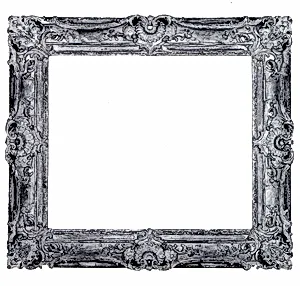
Swept frame
Unknown Artist
ca. 1730–40
Medium
Oak lower moldings and feather keys; lime upper moldings. Carved, gilt; orange-brown bole.
Dimensions
Overall: 33 11/16 × 37 5/8 in. (85.5 × 95.5 cm) Sight: 23 1/16 × 26 15/16 in. (58.5 × 68.5 cm) Rabbet: 24 × 28 5/8 in. (61 × 72.7 cm)
Classification
Frames
Culture
French
Department
Robert Lehman Collection
Museum
Metropolitan Museum of Art, New York, NY
Credit
Robert Lehman Collection, 1975
Accession Number
1975.1.2537
Rights
Public Domain
Art Historical Context
Step into the opulent world of 18th-century with this exquisite *Swept frame*, crafted around 1730–40. Hailing from the Louis XV era, it exemplifies the Rococo style's love for graceful curves and playful asymmetry. "Swept" frames this one feature boldly scrolling moldings that sweep outward from the sight edge, creating a dynamic sense of movement that draws the eye to the painting it once cradled—likely a portrait of nobility. Such frames were not mere supports but artistic statements, enhancing the grandeur of aristocratic interiors. Masterfully constructed, the frame employs oak for the sturdy lower moldings and feather keys, with lighter lime wood for the upper sections. Artisans carved intricate motifs, then applied orange-brown bole—a clay undercoat—for a warm glow beneath the gilding, achieving a luxurious gold finish that mimicked solid gold at a fraction of the cost. This technique highlights the French cabinetmakers' technical prowess and their role in elevating decorative arts to high fashion. Now housed in the Robert Lehman Collection at The Metropolitan Museum of Art (acquired 1975), this frame stands alone as a testament to Rococo craftsmanship. Though its artist remains unknown, its preservation offers a glimpse into the lavish tastes of pre-Revolutionary France, where every detail shimmered with elegance. (198 words)