
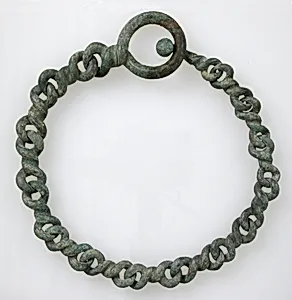
Sword Chain
Unknown Artist
4th century BCE
Medium
Copper alloy
Dimensions
Overall: 18 1/4 x 1 5/8 x 1/2 in. (46.3 x 4.1 x 1.3 cm)
Classification
Metalwork-Bronze
Culture
Celtic
Department
Medieval Art
Museum
Metropolitan Museum of Art, New York, NY
Credit
Gift of J. Pierpont Morgan, 1917
Accession Number
17.191.256
Rights
Public Domain
Art Historical Context
Behold the *Sword Chain*, a masterful example of Celtic metalwork from 4th century BCE crafted by an unknown artist in copper alloy. Measuring 18¼ x 1⅝ x ½ inches, this slender yet robust piece was likely used to suspend a sword from a warrior's belt, practicality with striking ornamentation. Housed in the Metropolitan Museum of Art's Medieval Department (gift of J. Pierpont, 1917), it exemplifies the La Tène style of Celtic artistry, characterized by intricate swirling motifs and technical prowess in bronze-like alloys. Celtic craftsmen of Iron Age Europe were renowned for their innovative metalworking, often employing lost-wax casting or hammering techniques to create objects that symbolized status and prowess. This chain's survival speaks to the durability of copper alloys—mixtures of copper and tin (essentially bronze)—which resisted corrosion while allowing for elaborate decoration. In Celtic society, such accessories adorned elite warriors, evoking the interconnected worlds of warfare, craftsmanship, and mythology. Though modest in scale, the *Sword Chain* offers a window into a vibrant prehistoric culture, where everyday tools became art. Visitors, imagine it swaying at a chieftain's side amid ancient battles— a testament to enduring Celtic ingenuity.