
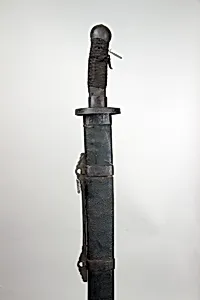
Sword with Scabbard
Unknown Artist
18th–19th century
Medium
Steel, iron, leather
Dimensions
H. with scabbard 37 3/4 in. (95.9 cm); H. without scabbard 35 3/4 in. (90.8 cm); H. of blade 29 in. (73.7 cm); W. 3 1/2 in. (8.9 cm); W. of blade 1 3/4 in. (4.5 cm); Wt. 2 lb. 12 oz. (1247.4 g); Wt. of scabbard 1 lb. 0.1 oz. (456.4 g)
Classification
Swords
Culture
Chinese
Department
Arms and Armor
Museum
Metropolitan Museum of Art, New York, NY
Credit
Bequest of George C. Stone, 1935
Accession Number
36.25.1629a, b
Rights
Public Domain
Art Historical Context
This elegant Sword with Scabbard, in China during the 18th 19th century, the masterful blacksmithing of the Qing Dynasty era. Measuring 37¾ inches (95.9 cm) with itsabbard, the weapon features a steel blade nearly 29 inches (73.7 cm) long, paired with iron fittings and a leather sheath for protection and balance. Weighing just over 2 pounds (1247 g) without the scabbard, its proportions reflect a design optimized for both combat effectiveness and portability, highlighting the fusion of form and function in Chinese arms. In Chinese culture, swords held profound symbolic value beyond warfare—as emblems of scholarly virtue, imperial authority, and martial prowess. Forged from high-quality steel and iron, this example showcases traditional techniques like differential hardening, which produced resilient yet flexible blades capable of withstanding rigorous use. The leather scabbard, lightweight at about 1 pound (456 g), underscores practical craftsmanship suited to mounted or foot soldiers. Acquired through the 1935 bequest of George C. Stone to the Metropolitan Museum of Art's Arms and Armor Department, this sword offers visitors a tangible link to China's dynamic military history, inviting reflection on the artistry behind tools of power.