
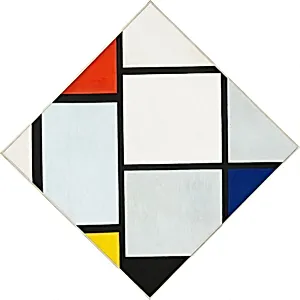
Tableau No. IV; Lozenge Composition with Red, Gray, Blue, Yellow, and Black
c. 1924/1925
Medium
oil on canvas
Dimensions
overall (diamond): 142.8 x 142.3 cm (56 1/4 x 56 in.) framed: 150.8 x 150.5 x 6.3 cm (59 3/8 x 59 1/4 x 2 1/2 in.)
Classification
Painting
Department
CMC
Museum
National Gallery of Art, Washington, D.C.
Credit
Gift of Herbert and Nannette Rothschild
Accession Number
1971.51.1
Rights
Public Domain
Art Historical Context
Piet Mondrian’s *Tableau No. IV; Lozenge Composition with Red, Gray Blue, Yellow, and* (c. 1924/192) exemplifies the artist’s mature exploration of neoplasticism, the movement he helped pioneer through the Dutch group De Stijl. Painted in oil on canvas, the work is presented as a diamond-shaped lozenge, rotated forty degrees so that its corners point toward the cardinal directions. Thick black lines intersect across the surface, dividing it into rectangles and squares that are filled with the primary colors Mondrian favored, along with neutral gray and black. This format was not merely decorative; by tilting the canvas, Mondrian created a sense of dynamic equilibrium that draws the viewer’s eye across the composition in multiple directions. The restrained palette and precise geometry reflect his belief that pure abstraction could express universal harmony and order, ideals that gained urgency in the years following World War I. Measuring roughly 142 centimeters on each side, the painting’s imposing scale invites quiet contemplation, allowing visitors to experience how Mondrian transformed simple forms into a balanced, almost musical arrangement of color and space.
About the Artist
Piet Mondrian · 1872–1944
**Piet Mondrian** (born Pieter Cornelis Mondriaan, 7 March 1872 – 1 February 1944) was a Dutch painter and theoretician who became one of the most influential figures in 20th-century abstract art. Born in Amersfoort, Netherlands, as the second of his parents’ children, he grew up in a creative household; his father was a qualified drawing teacher and headmaster, while his uncle, Frits Mondriaan, a...