
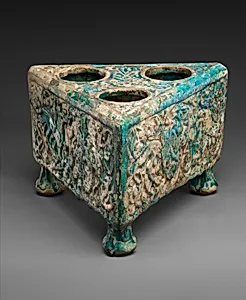
Tabouret with Winged Griffins and Benedictions
Unknown Artist
12th century
Medium
Earthenware; molded, modeled, glazed in turquoise
Dimensions
H. 8 1/8 in. (20.6 cm) W. 11 7/8 in. (30.2 cm) D. 10 in. (25.4 cm)
Classification
Ceramics
Department
Islamic Art
Museum
Metropolitan Museum of Art, New York, NY
Credit
Henry G. Leberthon Collection, Gift of Mr. and Mrs. A. Wallace Chauncey, 1957
Accession Number
57.61.13
Rights
Public Domain
Tags
Art Historical Context
This charming 12th-century tabouret, or low stool, from the world exemplifies the exquisite ceramics of the medieval period. Crafted from earthenware, was skillfully molded and modeled with dynamic winged griffins—mythical beasts symbolizing strength and guardianship—before being glazed in a vibrant turquoise. Measuring just over 8 inches tall, 11⅞ inches wide, and inches deep, its compact form suggests it served both practical and decorative purposes in a domestic setting, perhaps as a footrest or small table. The turquoise glaze, a hallmark of Seljuk-era pottery from regions like Persia (modern Iran), reflects advanced fritware techniques that produced a luminous, durable finish resistant to wear. Molded reliefs of griffins, blending ancient Near Eastern motifs with Islamic artistry, flank benedictions—likely Arabic inscriptions invoking blessings—adding a layer of spiritual protection and auspiciousness to everyday life. Housed in the Metropolitan Museum of Art's Islamic Art Department, this piece from the Henry G. Leberthon Collection highlights the fusion of functionality, fantasy, and faith in medieval Islamic design, inviting us to appreciate the artisans' mastery in transforming clay into jewel-like splendor.