
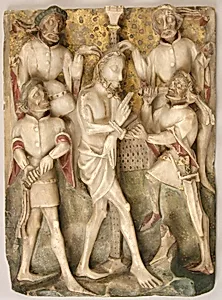
Taking of Christ
ca. 1440–50
Medium
Alabaster with paint and gilding
Dimensions
Overall: 14 3/4 x 11 1/8 x 2in. (37.5 x 28.3 x 5.1cm)
Classification
Sculpture-Stone
Culture
British
Department
Medieval Art
Museum
Metropolitan Museum of Art, New York, NY
Credit
Gift of Myron and Anabel Taylor, 1948
Accession Number
48.175.2
Rights
Public Domain
Tags
Art Historical Context
Behold the poignant *Taking of Christ*, a masterful alabaster relief carved by the School of Nottingham around 1440–50. This British medieval sculpture captures the dramatic moment of Jesus's betrayal and arrest in the Garden of Gethsemane, with Judas's kiss sealing his fate amid soldiers and disciples. Produced during the late Gothic period, it exemplifies the Nottingham school's specialty in affordable, vividly expressive religious carvings for private devotion, reflecting England's vibrant lay piety before the Reformation. Crafted from translucent Nottingham alabaster—a soft, easily carved stone quarried locally—the 14¾ x 11⅛-inch panel was once brightly painted and gilded, bringing the scene to life with jewel-like colors and shimmering gold highlights. Though traces of pigment remain, these techniques heightened emotional intensity, making sacred narratives accessible to everyday worshippers rather than just church elites. Such reliefs were mass-produced and exported across Europe, blending fine detail with devotional power. Housed in the Metropolitan Museum of Art's Medieval Art collection (gift of Myron and Anabel Taylor, 1948), this piece offers a window into 15th-century spirituality, where art bridged heaven and earth for ordinary folk. Its compact size suggests use on a home altar, inviting quiet contemplation of Christ's Passion.
About the Artist
School of Nottingham
**School of Nottingham** The School of Nottingham, a prolific workshop tradition of alabaster carvers based in Nottingham and surrounding Midlands areas like South Derbyshire, flourished from the fourteenth to the early sixteenth century, with its peak in the fifteenth. Quarrying soft gypsum alabaster locally, these anonymous image-makers—known as alabastermen, kervers, or marblers—produced thous...