
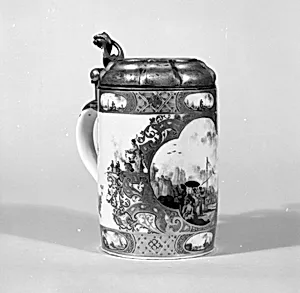
Tankard
ca. 1730, cover 1737
Medium
Hard-paste porcelain, silver gilt
Classification
Ceramics-Porcelain
Culture
German, Meissen with German, Dresden mounts
Department
European Sculpture and Decorative Arts
Museum
Metropolitan Museum of Art, New York, NY
Credit
The Lesley and Emma Sheafer Collection, Bequest of Emma A. Sheafer, 1973
Accession Number
1974.356.484
Rights
Public Domain
Art Historical Context
This exquisite tankard from the Meissen Manufactory, to around 1730 with its silver-gilt cover added in 1737, the pinnacle of early 18th-century European artistry. Produced in Meissen, Germany—the first European site to successfully manufacture hard-paste porcelain in 1710—this vessel features the factory's signature translucent white body, paired with ornate Dresden silver-gilt mounts that elevate its functionality as a grand drinking tankard for wine or beer. Hard-paste porcelain was a revolutionary achievement, rivaling prized Chinese imports and fueling a craze among Europe's aristocracy. Meissen pieces like this were hand-painted, gilded, and often molded with intricate figural scenes or floral motifs in the emerging Rococo style, showcasing technical virtuosity in firing and decoration. The silver-gilt elements, hallmarks of Dresden craftsmanship, added opulence and protection, blending ceramic innovation with metalworking traditions. Housed in The Metropolitan Museum of Art's European Sculpture and Decorative Arts collection, this tankard from The Lesley and Emma Sheafer Collection highlights Meissen's role in transforming luxury goods into symbols of status and cultural refinement during the Baroque era. Visitors will appreciate its delicate gleam, a testament to enduring German ingenuity.
About the Artist
Meissen Manufactory · 1710–present
The Meissen Manufactory, established on June 6, 1710, by Augustus the Strong, Elector of Saxony and King of Poland, marked the dawn of true hard-paste porcelain production in Europe. Nestled at Albrechtsburg Castle in Meissen near Dresden, the Royal Polish and Electoral Saxon Porcelain Manufactory arose from alchemical experiments begun in 1708 by physicist Ehrenfried Walther von Tschirnhaus and p...