
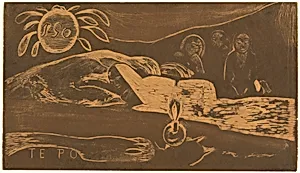
Te Po (The Long Night)
1894/1895
Medium
woodcut in bistre on cream paper
Classification
Department
CG-E
Museum
National Gallery of Art, Washington, D.C.
Credit
Rosenwald Collection
Accession Number
1947.12.55
Rights
Public Domain
Art Historical Context
**Te Po (The Night)**, created by Paul Gauguin 1894–1895, captures the artist's fascination Tahitian life and mythology his second voyage to the South Pacific. Gauguin, a leading Post-Impressionist and pioneer of Primitivism, sought escape from Western civilization inesia, where he immersed in indigenous culture. Thiscut, part of his *Noa Noa* series, evokes the mystical "long night" – "Te Po" in Maori – realm of dreams, spirits, and ancient legends that profoundly influenced his symbolic imagery. Printed in bistre (a warm, earthy brown ink) on cream paper, the work showcases Gauguin's innovative approach to woodcuts. He personally carved the blocks with rough, expressive lines inspired by Japanese ukiyo-e prints and Oceanic folk art, abandoning fine detail for bold, flattened forms and rhythmic patterns. This relief printing technique allowed him to produce affordable multiples, democratizing his exotic visions for a wider audience. Housed in the National Gallery of Art's Rosenwald Collection, *Te Po* exemplifies Gauguin's quest to blend European modernism with non-Western spirituality, challenging colonial perspectives and inspiring future artists like the Fauves and Expressionists. Visitors are drawn to its haunting atmosphere, a window into the artist's romanticized paradise.
About the Artist
Paul Gauguin · 1848–1903
Paul Gauguin (1848-1903) was a French Post-Impressionist painter whose bold experiments with color, form, and subject matter made him one of the most influential figures in the transition from 19th-century art to modernism. His rejection of European civilization for the perceived authenticity of 'primitive' cultures established an archetype of artistic exile that continues to resonate. Gauguin's ...