
Tea Bowl and Saucer
c. 1700
Medium
Gilded silver and enameled copper
Dimensions
Saucer: 2.3 × 14.2 cm (7/8 × 5 9/16 in.); Tea bowl: 5.9 × 12.3 × 8.3 cm (2 5/16 × 4 13/16 × 3 1/4 in.)
Classification
drinking vessel
Department
Applied Arts of Europe
Museum
Art Institute of Chicago
Accession Number
151562
Rights
Public Domain
About this artwork
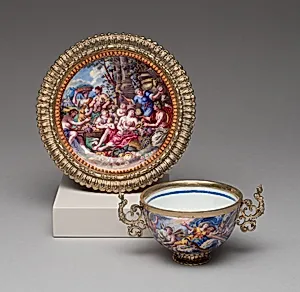
The complex enamel scenes on this tea service represent the four classical elements: air, earth, fire, and water. On one saucer Cybele, an Anatolian mother goddess who ruled over nature, personifies earth, while attendants present her with a bounty of animals, flowers, and fruit. The enamel’s pristine condition suggests that this tea service was rarely used; more likely, it was reserved for display as part of a collector’s cabinet.
Art Historical Context
Step into the opulent world of early 18th-century Europe with this exquisite *Tea Bowl and Saucer crafted by Matthäus B II around 1700. Housed in the Art Institute of Chicago's Department Applied Arts of Europe, drinking vessel exemplifies the era's lavish metalwork. The saucer measures a delicate 2.3 × 14.2 cm, while the bowl stands at 5.9 × 12.3 × 8.3 cm, perfectly proportioned for intimate tea rituals. Fashioned from gilded silver and enameled copper, the piece showcases advanced silversmithing techniques. Gilding—applying a thin layer of gold over silver—created a radiant, durable shine fit for aristocratic tables, while enameling on copper added vibrant, colorful details through fused glass powders. These methods highlighted the goldsmith's mastery, blending functionality with jewelry-like splendor. In an age when tea, newly popularized from Asia, symbolized status and refinement, such vessels were status symbols among Europe's elite. Baur's creation reflects the cultural fusion of Eastern imports and Western craftsmanship, inviting us to savor not just tea, but a slice of Baroque luxury.