
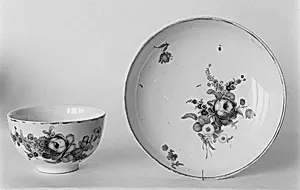
Teabowl and saucer
Medium
Hard-paste porcelain
Dimensions
Height (Teabowl): 1 7/8 in. (4.8 cm); Diameter (Saucer): 5 1/8 in. (13 cm)
Classification
Ceramics-Porcelain
Culture
Swiss, Zurich
Department
European Sculpture and Decorative Arts
Museum
Metropolitan Museum of Art, New York, NY
Credit
Gift of Henry G. Marquand, 1894
Accession Number
94.4.162, .163
Rights
Public Domain
Tags
Art Historical Context
This delicate teabowl and sa, produced by the Zurich Pottery and Porcelain Factory around 1775, exemplifies the of Swiss hard-paste porcelain during the late 18th century.ed from a high-fired, vitreous material that mimics the translucency and durability of prized Chinese exports, the set measures a dainty 1 7/8 inches in height for the bowl and 5 1/8 inches across the saucer. Adorned with floral motifs—a hallmark of European porcelain decoration—these pieces were designed for the intimate ritual of tea drinking, a fashionable pastime among Europe's elite. The Zurich factory, active in the Swiss city renowned for its precision craftsmanship, contributed to the wave of porcelain production that swept Europe after Meissen's breakthroughs. Hard-paste porcelain represented a technical triumph, allowing intricate painting and gilding that withstood daily use. This example, gifted to the Metropolitan Museum of Art in 1894 by Henry G. Marquand, highlights Zurich's role in the decorative arts, blending utility with elegance. Today, it invites visitors to appreciate how such everyday objects embodied cultural refinement, evoking the refined social gatherings of the Enlightenment era. A testament to Swiss ingenuity in the Department of European Sculpture and Decorative Arts.