
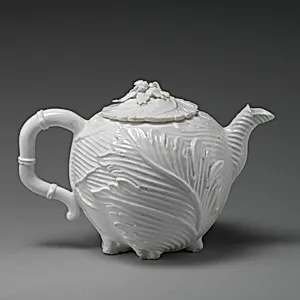
Teapot
ca. 1745–49
Medium
Soft-paste porcelain
Dimensions
Overall (confirmed): 4 13/16 × 6 7/8 × 4 1/4 in. (12.3 × 17.5 × 10.8 cm)
Classification
Ceramics-Porcelain
Culture
British, Chelsea
Department
European Sculpture and Decorative Arts
Museum
Metropolitan Museum of Art, New York, NY
Credit
Robert A. Ellison Jr. Collection, Gift of Robert A. Ellison Jr., 2014
Accession Number
2014.712.15a, b
Rights
Public Domain
Tags
Art Historical Context
This elegant teapot from the Chelseacelain Manufactory, around 1745–49, early British porcelain innovation. Produced during the short-lived but influential "Chelsea Gold Anchor" period, it measures a compact 4 13/16 × 6 7/8 × 4 1/4 inches, perfect for the intimate tea rituals sweeping 18th-century Britain. of soft-paste porcelain—a pioneering British blend of white clay and ground glass fired at lower temperatures than Chinese hard-paste—this medium allowed for delicate translucency and intricate molding, rivaling imported wares. Chelsea, one of England's first porcelain factories founded circa 1743, drew inspiration from Meissen and Sèvres, adopting a playful Rococo style. The teapot likely features acanthus leaf motifs, evoking classical antiquity in scrolling, organic forms that adorned rococo decorative arts. Its gilding and precise modeling highlight the manufactory's technical prowess, achieved through skilled slip-casting and hand-painting. Housed in the Metropolitan Museum of Art's European Sculpture and Decorative Arts department, this piece from the Robert A. Ellison Jr. Collection underscores tea's role in British social life and the era's luxury trade. A testament to national ambition, it captures the glamour of Georgian refinement.
About the Artist
Chelsea Porcelain Manufactory · 1744–1784
**Chelsea Porcelain Manufactory** The Chelsea Porcelain Manufactory, Britain's pioneering porcelain enterprise, was founded around 1743 in Chelsea, London, by two Huguenot silversmiths: Nicholas Sprimont from Liège and Charles Gouyn. Sprimont, trained in Paris as a goldsmith before immigrating to England, brought his expertise in luxury metalwork to the venture, while Gouyn handled early sales th...