
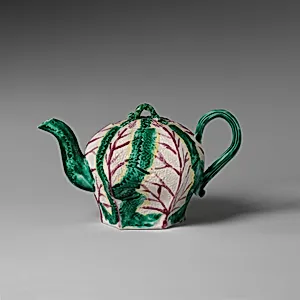
Teapot in the form of a cabbage
Unknown Artist
ca. 1760
Medium
Salt-glazed stoneware with enamel decoration
Dimensions
Overall: 4 × 6 3/4 in. (10.2 × 17.1 cm)
Classification
Ceramics-Pottery
Culture
British, Staffordshire
Department
European Sculpture and Decorative Arts
Museum
Metropolitan Museum of Art, New York, NY
Credit
Gift of Carleton Macy, 1934
Accession Number
34.165.119a, b
Rights
Public Domain
Art Historical Context
This delightful "Teapot in the form a cabbage," crafted around 1760 in Staffordshire, Britain, exemplifies the playful whimsy of 18th-century British ceramics. Staffordshire was a thriving hub for pottery production during the Industrial Revolution's early days, where potters innovated affordable alternatives to expensive Chinese porcelain. Shaped like a plump cabbage with leaves forming the handle and spout, this compact piece (just 4 × 6 3/4 inches) captures the Rococo era's love for nature-inspired novelty objects, blending functionality with humor for the tea-loving middle class. Made of salt-glazed stoneware—a durable, everyday material—the teapot's surface achieves a distinctive orange-peel texture and glossy finish through a unique firing process: salt vaporized in the kiln reacts with the clay to create a glassy coating. Vibrant enamel decoration adds colorful accents, highlighting the vegetable motifs and making it a standout in domestic display. Unlike fragile porcelain, salt-glazed ware was practical for households, yet its sculptural elevated it to decorative art. Today, housed in the Metropolitan Museum of Art's European Sculpture and Decorative Arts department (gift of Carleton Macy, 1934), this teapot reveals how Staffordshire artisans democratized luxury, infusing daily rituals like tea-drinking with botanical charm and technical ingenuity. A charming snapshot of Georgian ingenuity!