
Teapot
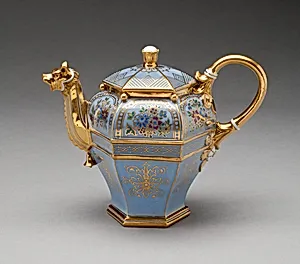
Medium
Hard-paste porcelain with polychrome enamels and gilding
Dimensions
14 × 17.8 × 9.4 cm (5 1/2 × 7 × 3 11/16 in.)
Classification
teapot
Department
Applied Arts of Europe
Museum
Art Institute of Chicago
Accession Number
207688
Rights
Public Domain
Art Historical Context
This elegant teapot, created by the Manufacture nationale de Sèvres between 1832 and 1835, exemplifies the refined artistry of French porcelain production during the early nineteenth century. As the official national manufactory, Sèvres had long supplied the French court and elite with luxury wares, and this piece reflects the continued prestige of the workshop even after the fall of the monarchy. Its compact form, measuring just over five inches in height, was designed for both everyday use and display, blending utility with ornamental beauty. Crafted from hard-paste porcelain and finished with vibrant polychrome enamels and delicate gilding, the teapot highlights the technical mastery that made Sèvres renowned across Europe. The durable hard-paste body allowed for intricate shapes and rich surface decoration, while the enamels and gold accents added depth and luminosity. Such works belonged to the broader tradition of applied arts, where functional objects became vehicles for artistic expression and status. Today housed in the Art Institute of Chicago’s Department of Applied Arts of Europe, this teapot offers visitors a glimpse into the intersection of craftsmanship, design, and cultural refinement in post-revolutionary France.
About the Artist
Manufacture nationale de Sèvres · 1763–1800
The Manufacture nationale de Sèvres, a premier French porcelain factory, flourished from 1763 to 1800 as the royal powerhouse of European ceramics, producing opulent soft- and hard-paste porcelain under the patronage of Louis XV and XVI. Originally founded in Vincennes in 1740 to rival Meissen and Chantilly, it relocated to Sèvres in 1756 and was fully acquired by the Crown in 1759, becoming the M...