
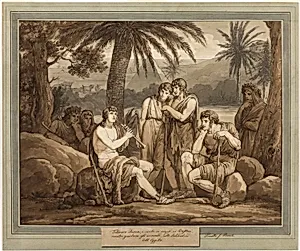
Telemachus Plays and Sings to the Shepherds in Egypt, from The Adventures of Telemachus, Book 2
Medium
Pen and black ink, with brush and brown and gray wash, over traces of black chalk on ivory laid paper, laid down on board
Dimensions
Sight: 46 × 58.8 cm (18 1/8 × 23 3/16 in.); Overall: 55.8 × 66.7 cm (22 × 26 5/16 in.)
Classification
drawings (visual works)
Department
Prints and Drawings
Museum
Art Institute of Chicago
Accession Number
17991
Rights
Public Domain
About this artwork
These twelve drawings depict scenes from the French novel The Adventures of Telemachus (Les aventures de Télémaque) by François Fénelon. First published in 1699, it was one of the most popular books of the 1700s and 1800s. Telemachus is the son of Ulysses from Homer’s Odyssey, the first four books of which describe the hero’s search for his father. Fénelon invented further adventures for Telemachus, in which he undergoes many trials while accompanied by his tutor, Mentor, who is actually the go...
Art Historical Context
Bartolomeo Pinelli’s 1808 drawing captures a pivotal moment from François Fénelon’s popular didactic novel *The Adventures of Telemachus* (1699). In this scene, the young Telemachus—son of Odysseus—entertains Egyptian shepherds with song and lyre, embodying the story’s themes of virtue, leadership, and cross-cultural encounter. Pinelli, an Italian artist renowned for his lively literary and classical illustrations, brings the episode to life with a sweeping composition that invites viewers into an imagined ancient world. Executed in pen and black ink with delicate layers of brown and gray wash over faint chalk underdrawing, the work demonstrates Pinelli’s mastery of tonal contrast and narrative clarity. The washes create atmospheric depth, suggesting both the warmth of an Egyptian landscape and the emotional resonance of Telemachus’s performance. Such drawings often served as designs for prints that circulated widely, helping to spread Enlightenment-era moral tales across Europe. Housed in the Art Institute of Chicago’s Prints and Drawings collection, this sheet reflects the early-nineteenth-century fascination with classical literature and the educational power of art. Its generous scale and refined technique make it an engaging window onto both ancient myth and the period’s cultural ideals.
About the Artist
Bartolomeo Pinelli · 1781–1835
Bartolomeo Pinelli (1781–1835) was an Italian artist and printmaker who became one of the most popular and prolific chroniclers of Roman popular life in the early nineteenth century. Born in Rome, he trained at the Accademia di San Luca and demonstrated precocious talent in drawing and sculpture, though it was as an engraver and illustrator that he found his true vocation and his widest audience. ...