
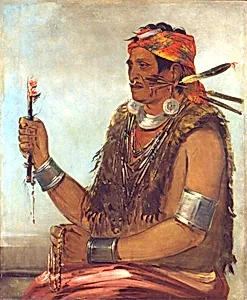
Ten-sqúat-a-way, The Open Door, Known as The Prophet, Brother of Tecumseh
1830
Medium
Painting
Classification
Painting
Department
Smithsonian Collection
Museum
Smithsonian American Art Museum
Credit
Smithsonian American Art Museum, Gift of Mrs. Joseph Harrison, Jr.
Accession Number
1985.66.279
Rights
Public Domain
Tags
About this artwork
“The ‘Shawnee Prophet,’ is perhaps one of the most remarkable men, who has flourished on these frontiers for some time past. This man is brother of the famous Tecumseh, and quite equal in his medicines or mysteries, to what his brother was in arms; he was blind in his left eye, and in his right hand he was holding his ‘medicine fire,’ and his ‘sacred string of beads’ in the other. With these mysteries he made his way through most of the North Western tribes, enlisting warriors wherever he went, ...
Art Historical Context
George Catlin's 1830 portrait *Ten-sqúat-a-way, The Open Door, Known as The Prophet Brother of Tecumseh* captures a pivotal figure in early 19th-century Native American history. Catlin, a pioneering artist dedicated to documenting Indigenous peoples of the American West, painted this during his first journey westward, likely at Fort Leavenworth present-day Kansas. As a master of realistic portraiture, Catlin aimed to preserve the likenesses and cultural details of his subjects before rapid settlement altered their worlds. The subject, Tenskwatawa—the Shawnee Prophet and brother of the renowned warrior Tecumseh—is depicted with striking authenticity. Blind in his left eye, he holds his "medicine fire" in one hand and a "sacred string of beads" in the other, symbols of his spiritual authority. Catlin's vivid account notes how Tenskwatawa traveled among Northwestern tribes, rallying thousands to join Tecumseh's vision of a pan-Indian confederacy to resist white encroachment and protect Indigenous lands. Though political rivals later branded him an imposter, derailing his plans, his influence endured. This oil painting, now in the Smithsonian American Art Museum (gift of Mrs. Joseph Harrison, Jr.), exemplifies Catlin's ethnographic artistry. Through meticulous observation, it offers a window into Shawnee spirituality and the fierce resistance against American expansion, blending historical record with human portraiture for timeless insight.
About the Artist
George Catlin · 1796–1872
George Catlin (1796–1872), born in Wilkes-Barre, Pennsylvania, to Putnam Catlin and Polly Sutton—who had been captured by Native Americans during the 1778 Battle of Wyoming—initially pursued a legal career. Trained at Litchfield Law School, he was admitted to the bar in 1819 but abandoned law after two years to study art in Philadelphia in 1823. Self-taught as a portraitist, Catlin quickly gained ...