
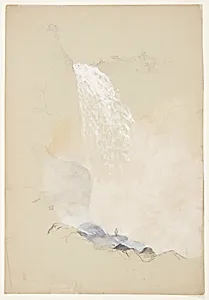
Tequendama Falls near Bogotá, Colombia
June 20-30, 1853
Medium
landscapes
Classification
landscapes
Department
Smithsonian Collection
Museum
Smithsonian American Art Museum
Credit
Gift of Louis P. Church
Accession Number
1917-4-701
Rights
Public Domain
About this artwork
Research in Progress
Art Historical Context
Frederic Edwin Church, a leading figure of the Hudson River School, the majestic Tequendama Falls near, Colombia, during a sketching trip from June 20-30, 1853. Inspired by explorer Alexander von Humboldt's romantic descriptions of South America's natural wonders, Church traveled to the region to document its sublime landscapes. This oil sketch, now in the Smithsonian American Art Museum's collection (gift of Louis P. Church), reflects his firsthand encounter with the cascading waters plunging into a misty gorge, embodying 19th-century American fascination with exotic, untamed nature. Church's luminist style shines here through meticulous detail and dramatic lighting, creating a sense of awe and divine order in the wilderness. His precise brushwork highlights the falls' turbulent energy against lush foliage, blending scientific observation with emotional intensity—a hallmark of the Hudson River School's emphasis on the American sublime. Though smaller than his grand studio canvases, this work served as a vital study for larger paintings, showcasing his innovative plein air techniques. Housed in the Smithsonian Collection, *Tequendama Falls* invites visitors to ponder how 19th-century artists like Church bridged exploration and art, fueling national pride in nature's grandeur while hinting at the environmental themes that resonate today.