
Terminal Figure of Ceres
1911
Medium
Painting
Classification
Painting
Department
Smithsonian Collection
Museum
Smithsonian American Art Museum
Credit
Smithsonian American Art Museum, Transfer from Cooper-Hewitt Museum of Decorative Arts and Design, Smithsonian Institution
Accession Number
1974.69.9
Rights
Public Domain
Tags
About this artwork
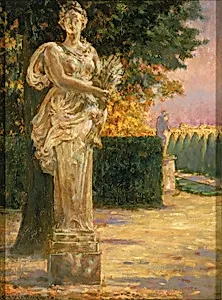
This painting shows a statue of Ceres in a garden of Versailles, France. Ceres was the Roman goddess of harvest and fertility, and among her symbols are sheaves of grain. Carroll Beckwith created this painting in September, and the scene glows with the vibrant light of autumn.
Art Historical Context
In the sun-drenched gardens of Versailles, Carroll Beckwith captured the serene beauty of the *Terminal Figure of Ceres in this 1911 painting. Created during a vibrant September visit, the work glows with the warm, light of autumn, highlighting the ancient statue of Ceres, the Roman goddess harvest and fertility. Her symbols—often sheaves of grain—evoke abundance and the earth's bounty, standing as a timeless emblem amid the opulent French landscape designed by André Le Nôtre in the 17th centuryBeckwith, an American artist known for his evocative European scenes, employs a luminous palette to render the statue's classical form against lush foliage, blending reverence for antiquity with the fleeting magic of seasonal light. This oil painting, now in the Smithsonian American Art Museum's collection (transferred from the Cooper-Hewitt), reflects early 20th-century fascination with grand historical sites, inviting viewers to ponder Ceres' enduring role in mythology—from nurturing Demeter in Greek lore to symbolizing agricultural prosperity in Roman culture. A delightful nod to Versailles' sculpted heritage, the piece reminds us how art bridges epochs, turning stone into a living celebration of nature's cycles.
About the Artist
Carroll Beckwith (American) · 1852 –1917
American, Hannibal, Missouri 1852–1917 New York