
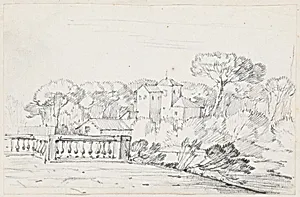
Terrace by a River with a Villa and Trees Beyond
1744/1750
Medium
graphite on laid paper
Dimensions
sheet: 11.7 x 18 cm (4 5/8 x 7 1/16 in.) page size: 42.5 x 27.7 cm (16 3/4 x 10 7/8 in.)
Classification
Drawing
Department
CG-E
Museum
National Gallery of Art, Washington, D.C.
Credit
Mark J. Millard Architectural Collection
Accession Number
1983.49.170
Rights
Public Domain
Art Historical Context
Joseph-Marie Vien's *Terrace by a River with a Villa and Trees Beyond (ca. 1744–1750) captures a serene landscape in delicate graphite on laid paper, a modest sheet measuring just 11.7 x 18 cm. Created early in Vien's career, this reflects the French artist's burgeoning interest in classical motifs during a pivotal era. Vien, a key precursor to Neoclassicism had recently won the prestigious Prix de Rome in 1743, likely immersing himself in Italianate scenes that blended natural beauty with architectural elegance—evident here in the terraced riverbank, distant villa, and lush trees. The work's intimate scale and precise graphite lines showcase 18th-century drafting techniques, where laid paper's textured surface held fine details ideal for studies. Such drawings often served as preparatory sketches for larger paintings or personal explorations, highlighting Vien's versatility beyond his renowned history paintings. Rococo flourishes were giving way to more structured compositions, and this piece hints at that shift toward idealized, harmonious landscapes inspired by antiquity. Housed in the National Gallery of Art's Mark J. Millard Architectural Collection (Department CG-E), it underscores the drawing's architectural allure, inviting visitors to appreciate how everyday vignettes like this terrace preserved the grandeur of 18th-century European vistas. A quiet gem for those tracing art's evolution from ornament to order.
About the Artist
Joseph-Marie Vien · 1716–1809
Joseph-Marie Vien (1716–1809) was born on 18 June in Montpellier, France, into a modest family, emerging as a child prodigy in painting. As a protégé of the Comte de Caylus, he entered the studio of Charles-Joseph Natoire at an early age, honing his skills in history painting. Winning the prestigious Prix de Rome in 1743, Vien traveled to Italy in 1744, spending six formative years in Rome studyin...