
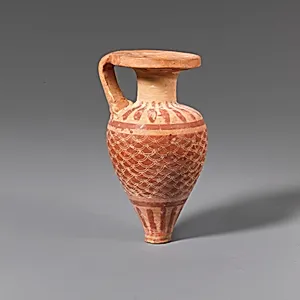
Terracotta pointed aryballos (oil flask)
Unknown Artist
ca. 640–625 BCE
Medium
Terracotta
Dimensions
H. as restored 2 1/2 in. (6.4 cm)
Classification
Vases
Culture & Period
Greek, Corinthian · Protocorinthian
Department
Greek and Roman Art
Museum
Metropolitan Museum of Art, New York, NY
Credit
Gift of Joseph Brummer, 1923
Accession Number
23.44
Rights
Public Domain
Art Historical Context
This delicate terracotta aryballos, or pointed oil flask, hails from Corinth, Greece, during the Protocorinth period around 640–625 BCE. Standing just 2½ inches tall as restored, it exemplifies the exquisite miniature pottery that Corinthian workshops produced in this formative era, bridging Geometric austerity and the emerging Orientalizing style. These small vessels were masterfully wheel-thrown from fired clay, often featuring intricate black-figure decoration with lively animal motifs—a hallmark of Protocorinthian innovation that influenced later Greek vase painting. Aryballoi like this one served a practical yet ritual purpose: men used them to hold perfumed olive oil for anointing the body before athletic events, baths, or ceremonies. The pointed base allowed it to be stuck into soft ground or sand for easy transport and stability, reflecting everyday life in Archaic Greece. Its compact size and fine craftsmanship highlight Corinth's dominance as a pottery exporter, trading these luxury items across the Mediterranean. Today, this gem resides in the Metropolitan Museum of Art's Greek and Roman Art Department, a generous 1923 gift from Joseph Brummer. It offers a window into the vibrant, interconnected world of early Greek culture, where art and utility danced in perfect harmony.