
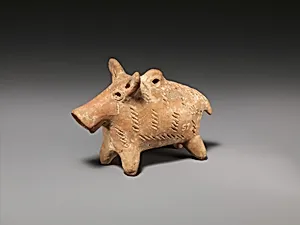
Terracotta boar figurine
Unknown Artist
ca. 2000–1800 BCE
Medium
Terracotta
Dimensions
H. 3 3/4 in. (9.5 cm)
Classification
Vases
Culture & Period
Cypriot · Early Cypriot III–Middle Cypriot I
Department
Greek and Roman Art
Museum
Metropolitan Museum of Art, New York, NY
Credit
The Cesnola Collection, Purchased by subscription, 1874–76
Accession Number
74.51.834
Rights
Public Domain
Tags
Art Historical Context
This charming terracotta boar figurine, standing just 3 3/4 inches (9.5 cm) tall, hails from ancient Cyprus during the Early Cypriot III to Middle Cypriot I periods (ca. 2000–1800 BCE). Craft from fired clay—a durable and accessible medium favored in the Bronze Age—this small sculpture captures the sturdy form of a boar, a motif that appears in tags associated with the piece. Its modest size suggests it may have served as a votive offering, amulet, or even a zoomorphic vessel, given its classification among vases in the Metropolitan Museum of Art's collection. In Cypriot culture of this era, terracotta figurines like this one offer a window into daily life and ritual practices on the island, a key Mediterranean crossroads before heavy Greek influence. The Cesnola Collection, acquired by subscription between 1874–76, brought many such treasures to the Met's Greek and Roman Art department, highlighting Cyprus's distinctive artistic traditions. Though the artist remains unknown, the figurine's survival speaks to the skill of local potters in modeling naturalistic animal forms from humble clay. Today, this little boar invites us to ponder the symbolic power of animals in prehistoric societies—perhaps evoking strength or fertility—while reminding us of the enduring allure of ancient craftsmanship. A true gem for any visitor!