
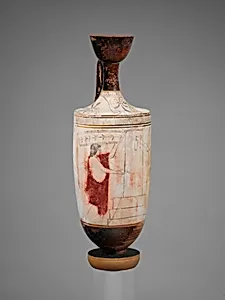
Terracotta lekythos (perfume flask)
ca. 460 BCE
Medium
Terracotta
Dimensions
H. 13 3/8 in. (34 cm)
Classification
Vases
Culture & Period
Greek, Attic · Classical
Department
Greek and Roman Art
Museum
Metropolitan Museum of Art, New York, NY
Credit
Rogers Fund, 1951
Accession Number
51.11.4
Rights
Public Domain
Tags
Art Historical Context
This elegant terracotta lekythos, or perfume flask, was crafted in Athens around 460 BCE during Greece’s Classical period. Standing just over 13 inches tall, the vessel have held scented oils for personal use or ritual offerings. As an Attic work, it reflects the refined artistic traditions of the city that dominated vase production in the ancient Mediterranean. The lekythos is attributed to the Sabouroff Painter, an accomplished artist known for his sensitive depictions of human figures. Painted in the red-figure technique typical of the era, the decoration likely captures graceful figures in quiet, everyday moments—an approach that moved away from earlier, more rigid Archaic styles toward greater naturalism and emotional depth. Such flasks were often placed in tombs, making them both functional objects and poignant memorials. Today in the Metropolitan Museum’s collection, this piece offers visitors a tangible connection to the refined tastes and beliefs of Classical Athens.
About the Artist
Sabouroff Painter
**The Sabouroff Painter** was an anonymous Athenian vase-painter active during the early Classical period, flourishing roughly between 470 and 440 BC. His conventional name was coined by Sir John Beazley after a nuptial lebes (a type of wedding bowl) formerly in the Sabouroff collection and now in Berlin; consistent stylistic traits across hundreds of surviving works confirm him as a distinct arti...