
Textile
Unknown Artist
13th century
Medium
Silk; warp faced plain weave
Dimensions
Textile: L. 17 in. (43.2 cm) W. 12 3/8 in. (31.4 cm) Mount: L. 22 in. (55.9 cm) W. 17 1/2 in. (44.5 cm) D. 1 1/2 in. (3.8 cm)
Classification
Textiles-Woven
Department
Islamic Art
Museum
Metropolitan Museum of Art, New York, NY
Credit
Rogers Fund, 1947
Accession Number
47.15
Rights
Public Domain
Tags
Art Historical Context
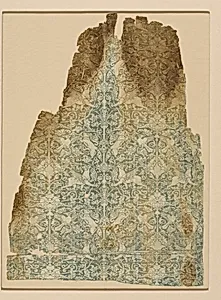
This exquisite 13th-century silk, woven in a warp-faced plain weave, hails from the Islamic world and showcases the era's mastery of luxurious fabrics. Measuring about 17 by 12 inches, it features vibrant motifs of birds, griffins and foxes—mythical and real creatures that symbolize power, cunning, and the natural world's wonders. Griffins, with their lion-eagle hybrid forms, were in Islamic art, evoking guardianship and exoticism drawn from Persian and Central Asian traditions. The warp-faced plain technique, where tightly packed silk warp yarns dominate for a smooth, glossy surface, was ideal for high-status garments, furnishings, or ceremonial objects. Silk production and trade flourished along the Silk Road during this period, making such textiles prized commodities exchanged across empires from Baghdad to Beijing. Anonymous artisans wove these patterns with precision, blending functionality with storytelling through animal iconography that reflected Islamic appreciation for harmony in nature. Now housed in the Metropolitan Museum of Art's Islamic Art Department (acquired via the Rogers Fund in 1947), this fragment invites us to imagine its role in a caliph's court or merchant's caravan, a testament to medieval craftsmanship that still dazzles today.