
Textile Fragment
Unknown Artist
3rd–4th century
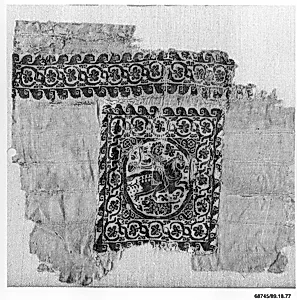
Medium
Wool, linen; plain weave, tapestry weave
Dimensions
Max. H. 11 1/4 in. (28.6 cm) Max. W. 10 5/16 in. (26.2 cm)
Classification
Textiles
Department
Islamic Art
Museum
Metropolitan Museum of Art, New York, NY
Credit
Purchase by subscription, 1889
Accession Number
89.18.77
Rights
Public Domain
Tags
Art Historical Context
This exquisite textile fragment, dating to the 3rd–4th century, offers a glimpse into the vibrant of Late Antique weaving from the ancient Near East or Egypt. Crafted from wool and linen using plain weave for the sturdy ground fabric and tapestry weave for colorful motifs, it measures just over 11 inches high and 10 inches wide The design prominently features horses, symbols of power, speed, and prestige in pre-Islamic cultures, likely rendered in rich dyed threads that have endured for over 1,600 years. Tapestry weave, a labor-intensive technique where weft yarns are woven back and forth to create patterns without floats, allowed artisans to produce detailed, reversible images ideal for garments, hangings, or saddle covers. Such fragments were common in daily life and elite burials, showcasing advanced dyeing and spinning skills passed down through generations. Housed in the Metropolitan Museum of Art's Islamic Art Department since its 1889 purchase, this piece bridges pre-Islamic traditions and later Islamic textile arts, highlighting the continuity of motifs like galloping steeds in rugs and fabrics across centuries. A testament to anonymous craftsmanship, it invites us to imagine the hands that wove these threads amid ancient trade routes.