
Textile Fragment
Unknown Artist
3rd–4th century
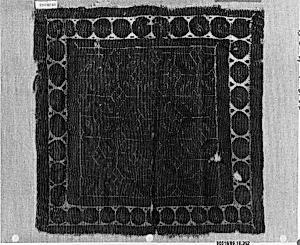
Medium
Wool, linen; plain weave, tapestry weave
Dimensions
H. 9 3/4 in. (24.8 cm) W. 9 3/4 in. (24.8 cm)
Classification
Textiles
Department
Islamic Art
Museum
Metropolitan Museum of Art, New York, NY
Credit
Purchase by subscription, 1889
Accession Number
89.18.262
Rights
Public Domain
Art Historical Context
This charming *Textile Fragment* from the 3rd–4th offers a glimpse into the sophisticated world of Late Antique weaving, preserved in the Metropolitan Museum of's Islamic Art department. Dating to a time of cultural exchange across the Mediterranean and Near East—under Roman, Byzantine, and early Sassanian influences—this small square piece (9¾ × 9¾ inches) originated from Egypt or Syria, regions pivotal to the development of textile traditions that later flourished in Islamic art. Acquired through a subscription purchase in 1889, it exemplifies the Met's early commitment to collecting artifacts that bridge ancient and medieval worlds. Crafted from wool and linen using plain weave for the sturdy ground fabric and tapestry weave for decorative elements, the fragment highlights masterful techniques that allowed weavers to create vibrant, durable patterns without modern machinery. Tapestry weave, where colored weft threads are woven directly into the warp to form motifs, was prized for its pictorial potential, often depicting figures, animals, or geometric designs in daily garments, hangings, or mummy wrappings. Though the exact imagery here is fragmented, such textiles reveal the era's vibrant dye trade and skilled labor, underscoring their role in personal adornment and ritual. These surviving snippets are treasures, as organic materials rarely endure millennia. They illuminate the artistic ingenuity of anonymous craftspeople whose innovations influenced Islamic textile arts for centuries, inviting us to appreciate the tactile artistry of antiquity.