
Textile Fragment
Unknown Artist
9th–10th century
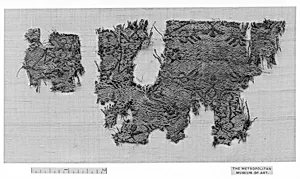
Medium
Silk; lampas (?)
Dimensions
Max. H. 3 3/8 in. (8.5 cm) Max. W. 4 15/16 in. (12.5 cm)
Classification
Textiles-Woven
Department
Islamic Art
Museum
Metropolitan Museum of Art, New York, NY
Credit
Gift of George F. Baker, 1890
Accession Number
90.5.3
Rights
Public Domain
Art Historical Context
This delicate *Textile Fragment*, dating to the 9th–10th, offers a glimpse into the opulent world of Islamic textile production during the Abbasid era. Crafted from silk in a possible lampas weave—a sophisticated technique layering a patterned supplementary weft over a sturdy ground fabric—this small piece (just 3⅜ × 4⅞ inches) survives as a testament to the era's masterful craftsmanship. Lampas was prized for its durability and sheen, ideal for luxurious garments, furnishings, and trade goods that symbolized wealth and status across the Islamic world, from Baghdad to Central Asia. In the Islamic Art collection at The Metropolitan Museum of Art—gifted by George F. Baker in 1890—this fragment highlights the technical prowess of anonymous weavers who blended functionality with artistry. Silk, often imported via the Silk Road, was woven into intricate designs that reflected cultural motifs like geometrics or florals, though wear has softened its details. Such textiles were essential to daily life and ritual, adorning mosques, palaces, and elite wardrobes. Though tiny, this artifact underscores the fragility and rarity of surviving medieval fabrics, preserving echoes of a vibrant trade network and artistic tradition that influenced global design for centuries.