
Textile Fragment
Unknown Artist
5th century
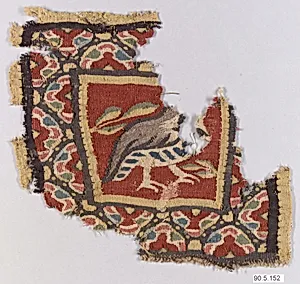
Medium
Wool, linen; plain weave, tapestry weave
Dimensions
Max. H. 7 1/2 in. (19 cm) Max. W. 7 1/2 in. (19 cm)
Classification
Textiles
Department
Islamic Art
Museum
Metropolitan Museum of Art, New York, NY
Credit
Gift of George F. Baker, 1890
Accession Number
90.5.152
Rights
Public Domain
Art Historical Context
This delicate textile fragment, dating to the 5th, offers a rare window into the sophisticated weaving traditions of late antiquity. Crafted from wool and linen plain weave for the foundation and tapestry weave for decorative elements, it measures just 7½ inches square—small enough to have adorned a garment, curtain, or household item. Housed in the Metropolitan Museum of Art's Department of Islamic Art, it the technical prowess of artisans in regions like Egypt or the Near East, where textiles bridged pre-Islamic and early Islamic cultures. Tapestry weave, a labor-intensive technique where colored weft threads completely cover the warp to create vibrant patterns, was prized for its durability and pictorial quality. Combined with the simpler plain weave, it allowed for both structural integrity and artistic expression, often featuring motifs of daily life, animals, or geometric designs—though this fragment's specific imagery has faded with time. These methods highlight how textiles served as portable art, traded along ancient routes and influencing later Islamic textile arts. A generous gift from George F. Baker in 1890, this piece reminds us of the everyday artistry that shaped civilizations, preserving techniques that endured for centuries.