
Textile Fragment
Unknown Artist
6th century
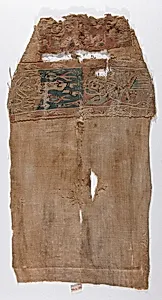
Medium
Wool, linen; plain weave, tapestry weave
Dimensions
Max. H. 20 1/16 in. (51 cm) Max. W. 8 3/4 in. (22.3 cm)
Classification
Textiles
Department
Islamic Art
Museum
Metropolitan Museum of Art, New York, NY
Credit
Gift of George F. Baker, 1890
Accession Number
90.5.190
Rights
Public Domain
Art Historical Context
This exquisite Textile Fragment, dating to the 6th century, offers a glimpse into the sophisticated weaving traditions of the early Islamic world. Crafted from wool and linen using plain weave for the foundation and tapestry weave for decorative elements, it exemplifies the technical mastery of ancient artisans. At just over 20 inches tall and 8¾ inches wide, this modest fragment likely originated from a larger garment, curtain, or furnishing, reflecting everyday luxury in a period bridging late antiquity and the dawn of Islam. The use of tapestry weave—a discontinuous weft technique—allowed weavers to create vibrant, detailed patterns with minimal yarn waste, a hallmark of Near Eastern and Coptic textile production. Wool provided durability and warmth, while linen added strength and a fine texture, making such pieces ideal for both practical and ornamental use. These methods influenced Islamic art for centuries, blending functionality with artistry. Housed in the Metropolitan Museum of Art's Islamic Art Department, this fragment was a generous gift from George F. Baker in 1890. It invites us to appreciate the anonymous creators whose innovations shaped cultural exchange across the Mediterranean and beyond, preserving threads of history in every stitch.