
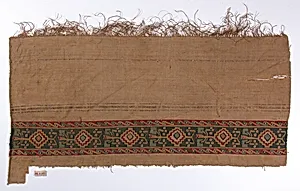
Textile Fragment
Unknown Artist
6th century
Medium
Wool, linen; plain weave, tapestry weave
Dimensions
Max. H. 8 1/4 in. (21 cm) Max. W. 18 in. wide (45.7 cm)
Classification
Textiles
Department
Islamic Art
Museum
Metropolitan Museum of Art, New York, NY
Credit
Gift of George F. Baker, 1890
Accession Number
90.5.371
Rights
Public Domain
Art Historical Context
This delicate Textile Fragment, dating to the 6th, offers a glimpse into the sophisticated textile arts of the early Islamic world. Crafted from wool and linen plain weave for the foundation and tapestry weave for decorative elements, it exemplifies the technical mastery of ancient weavers. Tapestry weave, a discontinuous weft technique, allowed artisans to create vibrant patterns by interworking colored yarns, a method prized for its durability and visual impact in garments, hangings, and furnishings. Housed in the Metropolitan Museum of Art's Islamic Department, this fragment—measuring a modest 8¼ inches high by 18 inches wide—survives as a testament to the region's thriving textile trade along Silk Road routes and Mediterranean ports. Though the artist remains unknown, such pieces highlight the cultural exchange between Byzantine, Sassanian, and emerging Islamic influences, where textiles served not just practical purposes but also as symbols of status and storytelling. A generous gift from George F. Baker in 1890, this artifact invites us to appreciate the enduring legacy of handwoven artistry, bridging the ancient past with our modern fascination for intricate craftsmanship.