
Textile Fragment
Unknown Artist
5th century
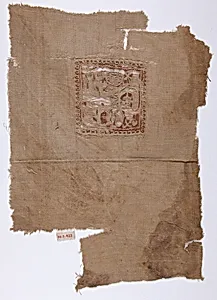
Medium
Wool, linen; plain weave, tapestry weave
Dimensions
Max. H. 9 5/8 in. (24.5 cm) Max. W. 11 7/16 in. (29 cm)
Classification
Textiles
Department
Islamic Art
Museum
Metropolitan Museum of Art, New York, NY
Credit
Gift of George F. Baker, 1890
Accession Number
90.5.423
Rights
Public Domain
Art Historical Context
This exquisite Textile Fragment, dating to the 5th, offers a glimpse into the sophisticated textile traditions of the late antique world, now housed in the Metropolitan Museum of's Islamic Art Department.ed from wool and linen using plain weave for the ground and tapestry weave for decorative elements, the fragment measures just 9⅝ by 11⅜ inches—likely a surviving piece from a larger garment, furnishing, or ritual cloth. Donated in 1890 by George. Baker, it exemplifies durability and artistry of early woven materials from regions bridging the Mediterranean and Near East. The dual-weave technique is particularly noteworthy: plain weave provided a sturdy base, while tapestry weave allowed artisans to create intricate, discontinuous patterns by interweaving colored wefts. This method, labor-intensive yet versatile, was prized for its ability to produce vibrant motifs without wasting yarn, a hallmark of pre-Islamic craftsmanship in areas like Egypt, Syria, or Persia that later influenced Islamic textile production. Culturally, such fragments highlight textiles' vital role in daily life, trade, and status during the 5th century—a time of cultural exchange under Roman, Sasanian, and emerging Byzantine influences. Preserved through arid burial contexts or careful storage, they reveal how wool and linen blended functionality with beauty, paving the way for the opulent woven arts of early Islam. A small treasure, it invites us to marvel at ancient hands shaping enduring legacies.