
Textile Fragment
Unknown Artist
3rd–4th century
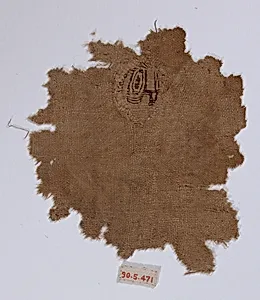
Medium
Wool, linen; plain weave, tapestry weave
Dimensions
Max. H. 4 15/16 in. (12.6 cm) Max. W. 4 9/16 in. (11.6 cm)
Classification
Textiles
Department
Islamic Art
Museum
Metropolitan Museum of Art, New York, NY
Credit
Gift of George F. Baker, 1890
Accession Number
90.5.471
Rights
Public Domain
Art Historical Context
This delicate textile fragment, dating to the 3rd–4th century, a glimpse into the sophisticated craftsmanship of Late Antiquity in regions later embraced by Islamic culture. Housed in the Metropolitan Museum Art's Department of Islamic Art, it measures just under 5 inches in both height and width, likely a surviving piece from a larger garment, furnishing, or ceremonial object. Donated in 1890 by George. Baker, it exemplifies enduring appeal of ancient textiles preserved through careful curation. Crafted from wool and linen using plain weave for the foundation and tapestry weave for decorative elements, the fragment highlights advanced weaving techniques. Plain weave provided a sturdy tabby structure, while tapestry weave—a discontinuous weft method—allowed weavers to create intricate patterns by interworking colored yarns, a labor-intensive process that conserved materials and enabled vibrant motifs without waste. Such fragments are invaluable for understanding early textile production, trade routes, and daily life across the Mediterranean and Near East. They reveal how wool and linen, abundant fibers, supported vibrant economies and artistic expression, bridging pre-Islamic traditions with the cultural flowering of the Islamic world. Visitors can appreciate how this tiny survivor connects us to artisans of nearly 1,700 years ago.