
Textile Fragment
Unknown Artist
3rd–4th century
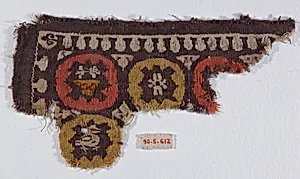
Medium
Wool, linen; tapestry weave
Dimensions
Max. H. 6 1/2 in. (16.5 cm) Max. W. 3 9/16 in. (9 cm)
Classification
Textiles
Department
Islamic Art
Museum
Metropolitan Museum of Art, New York, NY
Credit
Gift of George F. Baker, 1890
Accession Number
90.5.612
Rights
Public Domain
Art Historical Context
This delicate textile fragment, dating to the 3rd–4th century, offers a glimpse into the sophisticated weaving traditions of the Late Antique world. Crafted from wool and linen using the tapestry weave technique, it measures just 6½ by 3⅜ inches (16.5 by 9 cm), suggesting it is a surviving piece from a larger garment, furnishing, or burial shroud. Housed in the Metropolitan Museum of Art's of Islamic Art and gifted by George F. Baker in1890, it exemplifies the enduring appeal of ancient fabrics that bridge classical antiquity and later Islamic cultures. Tapestry weave, one of the most labor-intensive methods of its time, involves packing colorful weft threads tightly over a linen warp to create a dense, pictorial surface—much like a painting in fiber. Prevalent in regions like Egypt and the Near East, this technique allowed artisans to produce vibrant, durable textiles for elite use, reflecting advanced dyeing skills and trade in natural fibers. Though the artist remains unknown, such fragments highlight the anonymous mastery of ancient weavers. Surviving in such small scale, this piece underscores the fragility and rarity of textiles from this era, preserved often through arid burial conditions. It invites us to imagine the hands that wove it amid bustling workshops, connecting visitors to the daily artistry of a world in cultural transition.