
Textile Fragment
Unknown Artist
7th–8th century
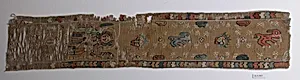
Medium
Wool, linen; tapestry weave
Dimensions
Max. H. 21 7/16 in. (54.5 cm) Max. W. 4 in. (10.2 cm)
Classification
Textiles
Department
Islamic Art
Museum
Metropolitan Museum of Art, New York, NY
Credit
Gift of George F. Baker, 1890
Accession Number
90.5.661
Rights
Public Domain
Art Historical Context
This exquisite *Textile Fragment* from the 7th–8th century offers a rare glimpse into early Islamic artistry, crafted during the Umayyad or early Abbasid eras when textile production flourished across the Islamic world. Made of wool and linen in a tapestry weave—a labor-intensive technique where colored weft threads are woven back and forth to form discrete motifs without floats on the reverse—this narrow strip (max. 21 7/16 in. high by 4 in. wide) likely originated from a garment, curtain, or furnishing. Such fragments survive due to their use in wrapping mummies or as trade goods along Silk Road routes, highlighting textiles' role as portable luxury items. Tapestry weave was prized for its durability and vivid color retention, allowing artisans to create intricate patterns symbolizing paradise gardens, geometric abstractions, or animal motifs—hallmarks of Islamic design that avoided human figures in sacred contexts. Though the exact imagery here is worn by time, its preservation speaks to the sophistication of weaving centers in Egypt, Syria, or Persia. A generous gift to the Metropolitan Museum of Art from George F. Baker in 1890, this piece resides in the Islamic Art department, inviting us to appreciate how textiles wove together culture, commerce, and craftsmanship in the formative centuries of Islam.