
Textile Fragment
Unknown Artist
ca. 1570–80
Medium
Silk, metal wrapped thread; lampas (kemha)
Dimensions
Textile: L. 123 1/2 in. (313.7 cm) W. 26 1/2 in. (67.3 cm) Tube: Diam. 2 1/2 in. (6.4 cm) W. 38 1/2 in. (97.8 cm)
Classification
Textiles-Woven
Department
Islamic Art
Museum
Metropolitan Museum of Art, New York, NY
Credit
Rogers Fund, 1944
Accession Number
44.41.2
Rights
Public Domain
Art Historical Context
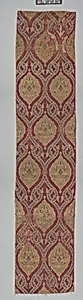
This exquisite *Textile Fragment* from 1570–80 hails from the Islamic world, likely the Ottoman Empire at the peak of its artistic splendor under sultans like Selim II. Acquired by The Metropolitan Museum of Art through Rogers Fund in 194, this woven silk piece exemplifies the opulence of 16th-century courtly textiles. Measuring an impressive 123½ inches long and 26½ inches wide, with a tubular section suggesting it may have formed part of a garment skirt, cushion cover, or ceremonial hanging, it reflects the era's mastery in creating lavish fabrics for elite patrons. Crafted in the lampas (kemha) technique—a complex weave where silk ground wefts interlace with pattern wefts of silk and metal-wrapped threads—this fragment shimmers with metallic highlights. Kemha was a hallmark of Ottoman Bursa weavers, prized for its durability, richness, and ability to mimic costly brocades. The use of metal threads, often gold or silver over a core, added a regal gleam, making such textiles status symbols in palaces and mosques. Though the precise motifs are not detailed here, this fragment's survival underscores the cultural prestige of Islamic textile arts, bridging artistry and craftsmanship. Visitors can marvel at how these fragments transport us to a time when fabric was as treasured as jewels.