
Textile Fragment
Unknown Artist
16th century
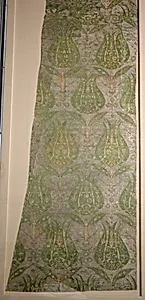
Medium
Silk, metal wrapped thread; lampas (kemha)
Dimensions
Textile: H. 52 in. (132.1 cm) W. 21 3/4 in. (55.2 cm) Mount: H. 58 1/2 in. (148.6 cm) W. 26 5/16 in. (66.8 cm)
Classification
Textiles-Woven
Department
Islamic Art
Museum
Metropolitan Museum of Art, New York, NY
Credit
Purchase, Joseph Pulitzer Bequest, 1952
Accession Number
52.20.16
Rights
Public Domain
Art Historical Context
This exquisite 16th-century textile fragment from the Islamic Art collection at the Metropolitan Museum of Art the luxurious weaving traditions of the Ottoman Empire.ed in silk with metal-wrapped threads, measures an impressive 52 inches high and 21¾ inches wide, suggesting it once formed part of a grand garment, curtain, or ceremonial hanging. Acquired through the Joseph Pulitzer Bequest in 2, such fragments highlight the era's opulent patronage of the arts, where textiles served as symbols of wealth and status. The standout technique is lampas, or *kemha* in Turkish—a complex weave structure that interlaces pattern wefts over a ground fabric to create vibrant, textured motifs. Often featuring floral, arabesque, or geometric designs, the metallic threads added a shimmering, jewel-like quality, mimicking gold or silver embroidery. Bursa, the Ottoman silk-weaving hub, was famed for these innovations, blending Persian influences with local mastery to produce fabrics exported across Europe and Asia. Though the artist remains unknown, this fragment's preservation offers a tactile glimpse into daily opulence and cultural exchange in the 16th century, reminding visitors of textiles' role as portable masterpieces in Islamic courts.