
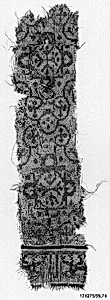
Textile Fragment
Unknown Artist
8th century
Medium
Wool
Dimensions
H. 24 in. (61 cm) W. 6 in. (15.2 cm)
Classification
Textiles-Woven
Department
Islamic Art
Museum
Metropolitan Museum of Art, New York, NY
Credit
Gift of J. Acheroff, 1959
Accession Number
59.74
Rights
Public Domain
Art Historical Context
This exquisite *Textile Fragment*, dating to the 8th century, offers a rare glimpse into the masterful weaving traditions of early Islamic art. Crafted wool in a woven technique, it measures 24 inches high by 6 inches wide (61 x 15.2 cm) and hails from the vibrant cultural crossroads of the Islamic world during the Umayyad or early Abbasid eras. Such fragments, preserved through the ages, highlight the era's advanced textile production, where wool was prized for its durability and versatility in garments, furnishings, and trade goods along Silk Road routes. In the Department of Islamic Art at The Metropolitan Museum of Art—acquired as a gift from J. Acheroff in 1959—this piece exemplifies the ingenuity of anonymous artisans. Woven textiles like this were not mere utilities but symbols of cultural exchange, blending influences from Byzantine, Persian, and Central Asian traditions. Their intricate patterns, often geometric or floral, reflected Islamic aniconism while showcasing technical prowess in looms and dyes. Though incomplete, the fragment's survival underscores the fragility and value of perishable arts, inviting us to imagine the opulent tapestries it once complemented in palaces or mosques. (198 words)