
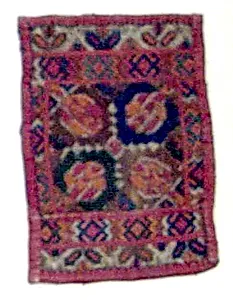
Textile Fragment
Unknown Artist
18th century
Dimensions
H. 9 1/2 in. (24.1 cm) W. 7 in. (17.8 cm)
Classification
Textiles
Department
Islamic Art
Museum
Metropolitan Museum of Art, New York, NY
Credit
Gift of Nanette B. Kelekian, in honor of Olga Raggio, 2002
Accession Number
2002.494.767
Rights
Public Domain
Art Historical Context
This exquisite *Textile Fragment* from the th century offers a glimpse into the opulent world of Islamic art where textiles were prized for their beauty and utility in garments, furnishings, and ceremonial objects. Housed in the Metropolitan Museum of Art's Department Islamic Art, this small—measuring just 9½ by 7 inches—survives as a testament to the era's masterful craftsmanship. Though the artist remains unknown and the precise medium is undocumented here, such fragments often feature silk, velvet, or metallic threads woven with intricate motifs like florals, geometrics, or arabesques, reflecting the Islamic tradition of aniconism and mathematical precision in design. In the 18th century, Islamic textile production flourished across regions like the Ottoman Empire, Safavid Persia, and Mughal India, serving as symbols of wealth, status, and cultural exchange along trade routes such as the Silk Road. These fabrics were not merely decorative; they embodied technical innovations like lampas weaving or brocading, blending functionality with artistry to create luminous, durable works. This fragment, gifted to the Met in 2002 by Nanette B. Kelekian in honor of Olga Raggio, invites us to appreciate the fragility of such survivals—often cut from larger panels—and their role in preserving the vibrant aesthetic legacy of Islamic civilizations. (198 words)