
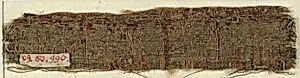
Textile with Confronted Parrots and Conventional Foliage
Unknown Artist
12th–13th century
Medium
Silk, linen
Dimensions
Overall: 6 3/4 x 1 1/2 in. (17.2 x 3.8 cm) Storage (Mat): 8 1/2 × 13 in. (21.6 × 33 cm)
Classification
Textiles-Woven-Brocade
Culture
German
Department
Medieval Art
Museum
Metropolitan Museum of Art, New York, NY
Credit
Rogers Fund, 1909
Accession Number
09.50.990
Rights
Public Domain
Art Historical Context
This exquisite fragment, *Textile with Confronted Parrots Conventional Foliage*,ails from 12th–13th Germany, a period when medieval artisans wove luxury textiles that blended Eastern influences with local craftsmanship. Produced during the High Middle Ages, such pieces adorned ecclesiastical vestments, noble garments, or altar cloths, symbolizing wealth and spiritual devotion. The symmetrical design features pairs of parrots facing each amid stylized foliage—a motif echoing Byzantine and Islamic patterns traded along Silk Road routes, adapted by German weavers to reflect Europe's growing cultural exchanges. Crafted as a woven brocade in shimmering silk and sturdy linen, the textile showcases advanced loom techniques where supplementary wefts created raised, metallic-like motifs against a tabby ground. At just 6 3/4 x 1 1/2 inches, this narrow strip likely served as a border or trimming, its compact scale highlighting the precision of medieval workshops. Acquired through the Rogers Fund in 1909, it now graces the Metropolitan Museum of Art's Medieval Art collection, offering a tangible glimpse into the opulent world of Gothic-era textiles. (178 words)