
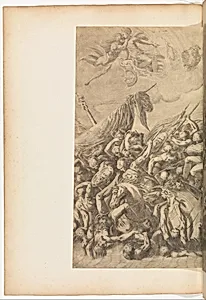
The Abduction of Helen
Medium
Etching
Classification
Prints
Department
Drawings and Prints
Museum
Metropolitan Museum of Art, New York, NY
Credit
Harris Brisbane Dick Fund, 1927
Accession Number
27.78.2(91)
Rights
Public Domain
Tags
Art Historical Context
Created in 1547 by the Venetian artist Andrea Schiav, also known as Andrea Meldola, *The Abduction of Helen* captures a pivotal moment from Greek mythology. The etching depicts the dramatic seizure of Helen, whose beauty sparked the Trojan War, with horses prominently featured in the composition to convey movement and urgency. As an etching, the work exemplifies the printmaking techniques that flourished during the Renaissance. This medium allowed artists to produce multiple impressions, broadening access to classical stories and artistic designs beyond the walls of palaces and churches. Schiavone’s print, now preserved in the Metropolitan Museum of Art’s collection of drawings and prints, reflects the era’s fascination with mythological themes and the growing role of prints in sharing cultural narratives. Acquired through the Harris Brisbane Dick Fund in 1927, the piece offers visitors a window into 16th-century interpretations of ancient legends. Its focus on Helen and the horses underscores the dynamic storytelling possible even within the intimate scale of an etching.
About the Artist
Andrea Schiavone (Andrea Meldola) · 1510–1563
Andrea Schiavone, born Andrea Meldolla around 1510 or 1515 in Zara (modern Zadar, Croatia), in Venetian-ruled Dalmatia, hailed from a family rooted in Meldola near Forlì in Romagna, Emilia-Romagna. His father, Simon Meldolla, served as a garrison commander there, and both parents originated from Meldola, where the family held property into the early 16th century. Nicknamed "Schiavone"—"the Slav"—a...