
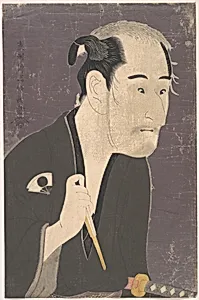
The Actor Onoye Matsusuke as a Ronin
Medium
Woodblock print; ink and color on paper
Dimensions
H. 14 7/8 in. (37.8 cm); W. 9 3/4 in. (24.8 cm)
Classification
Prints
Culture & Period
Japan · Edo period (1615–1868)
Department
Asian Art
Museum
Metropolitan Museum of Art, New York, NY
Credit
H. O. Havemeyer Collection, Bequest of Mrs. H. O. Havemeyer, 1929
Accession Number
JP1738
Rights
Public Domain
Tags
Art Historical Context
Created during Japan’s Edo period, this striking woodblock print captures the celebrated kabuki actor Onoye Matsusuke in the role of a ronin—a masterless samurai. Tōshūsai Sharaku, active only briefly in the 1790s, specialized in vivid portraits of stage performers. His works stand out for their ability to convey intense emotion and individual character through bold lines and expressive faces, offering viewers a glimpse into the dramatic world of kabuki theater that enthralled audiences of the time. Printed with ink and color on paper, the work exemplifies ukiyo-e, the popular “pictures of the floating world” that flourished in urban centers like Edo (modern-day Tokyo). These affordable prints allowed the public to own images of their favorite actors, much like modern celebrity memorabilia. The vertical format and dynamic pose emphasize the ronin’s dignified yet fierce presence, highlighting the tension and grace central to kabuki performance. Now part of the Metropolitan Museum’s renowned collection of Japanese art, this impression from the H. O. Havemeyer bequest preserves a vivid moment from Edo-period entertainment culture. Its restrained yet powerful color palette and masterful carving demonstrate the sophisticated collaboration between artist, carver, and printer that defined the medium.
About the Artist
Tōshūsai Sharaku · 1794–1795
Tōshūsai Sharaku stands as one of the most enigmatic figures in Japanese art history, a ukiyo-e printmaker whose brilliant career blazed for just ten months from the summer of 1794 to early spring 1795. Active exclusively in Edo (modern Tokyo), he produced approximately 150 woodblock prints and sketches, primarily yakusha-e—intimate portraits of kabuki actors captured mid-performance. Published by...