
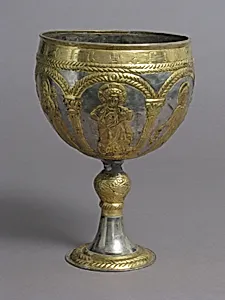
The Attarouthi Treasure - Chalice
Unknown Artist
500–650
Medium
Silver and gilded silver
Dimensions
Overall: 9 9/16 x 6 5/8 in. (24.3 x 16.8 cm) Diam. of foot: 3 7/8 in. (9.9 cm) Diam. of knop: 1 5/8 in. (4.1 cm) Capacity of cup: 2100 ml
Classification
Metalwork-Silver
Culture
Byzantine
Department
Medieval Art
Museum
Metropolitan Museum of Art, New York, NY
Credit
Purchase, Rogers Fund and Henry J. and Drue E. Heinz Foundation, Norbert Schimmel and Lila Acheson Wallace Gifts, 1986
Accession Number
1986.3.1
Rights
Public Domain
Tags
Art Historical Context
Behold the Chalice from the Attarouthi Treasure, stunning example of Byzantine metalwork crafted between 500 and 650 CE. This vessel, hailing from the early Medieval period, exemplifies the artistry of the Byzantine Empire, where Christian devotion intertwined with exquisite craftsmanship. Part of a larger hoard discovered in Syria, it served as a liturgical chalice for the Eucharist, its generous capacity of 2100 mloring its role in communal worship. Forged from silver and gilded silver, the chalice gleams with a luxurious finish achieved through mercury-gilding techniques, where a gold-mercury amalgam was applied and fired to create a radiant surface. Adorned with depictions of Christ, the Virgin Mary, and saints—hallmarks of Byzantine iconography—the vessel's elegant form (standing 9 9/16 inches tall with a sturdy foot and knop) reflects the era's fusion of functionality and symbolism, blending imperial opulence with spiritual depth. Acquired by The Metropolitan Museum of Art in 1986 through generous gifts, this chalice offers a window into Byzantine religious life, highlighting the enduring legacy of early Christian treasures that survived centuries of turmoil. A testament to anonymous artisans' skill, it invites visitors to marvel at the sacred splendor of the past.