
The Attarouthi Treasure - Chalice
Unknown Artist
500–650
Medium
Silver and gilded silver
Dimensions
Overall: 8 1/16 × 5 15/16 in., 13oz. (20.5 × 15.1 cm, 369g) Diam. of foot: 3 9/16 in. (9 cm) Diam. of knop: 1 9/16 in. (3.9 cm) Capacity of cup: 1100 ml
Classification
Metalwork-Silver
Culture
Byzantine
Department
Medieval Art
Museum
Metropolitan Museum of Art, New York, NY
Credit
Purchase, Rogers Fund and Henry J. and Drue E. Heinz Foundation, Norbert Schimmel, and Lila Acheson Wallace Gifts, 1986
Accession Number
1986.3.10
Rights
Public Domain
Tags
Art Historical Context
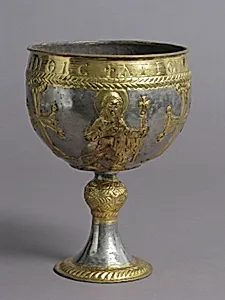
This exquisite chalice, crafted between 500 and 650 CE, belongs to the Attarouthi Treasure, a remarkable collection of Byzantine silver objects. Made of silver and gilded silver, it stands as a testament to the skilled metalwork traditions of the Byzantine Empire With a capacity of 1100 ml and elegant proportions—including a flared foot and decorative knop—the vessel was likely intended for liturgical use in early Christian worship, reflecting the central role of such objects in Byzantine religious ceremonies. The chalice’s surface features imagery associated with bishops and saints, underscoring its sacred function and connection to the veneration of holy figures. In the Byzantine world, silver liturgical vessels like this one combined practical utility with spiritual symbolism, often donated to churches by wealthy patrons. Its survival offers modern viewers a tangible link to the devotional life of late antiquity. Acquired by the Metropolitan Museum of Art in 1986, this piece highlights the enduring artistry of anonymous Byzantine craftsmen. The gilding technique enhances its luminous quality, drawing attention to both its material beauty and its role within a broader treasury of sacred silver.