
The Attarouthi Treasure - Chalice
Unknown Artist
500–650
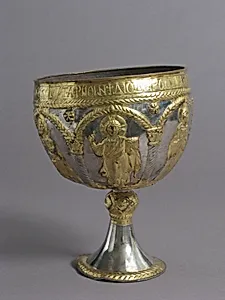
Medium
Silver and gilded silver
Dimensions
Overall: 8 1/16 × 6 1/4 in., 12.2oz. (20.4 × 15.9 cm, 347g) Diam. of foot: 3 11/16 in. (9.4 cm) Diam. of knop: 1 5/16 in. (3.4 cm) Capacity of cup: 1550 ml
Classification
Metalwork-Silver
Culture
Byzantine
Department
Medieval Art
Museum
Metropolitan Museum of Art, New York, NY
Credit
Purchase, Rogers Fund and Henry J. and Drue E. Heinz Foundation, Norbert Schimmel, and Lila Acheson Wallace Gifts, 1986
Accession Number
1986.3.5
Rights
Public Domain
Tags
About this artwork
This silver and gilded silver chalice forms part of the renowned Attarouthi Treasure, one of the most significant surviving ensembles of early Byzantine liturgical objects. Created between 500 and 650 CE, these vessels originally belonged to a Christian church in the prosperous merchant town of Attarouthi in Syria, then among the richest lands of the Byzantine Empire. The chalices, censers, and strainer were essential implements for celebrating the Divine Liturgy, or Eucharist, in which Christia...