
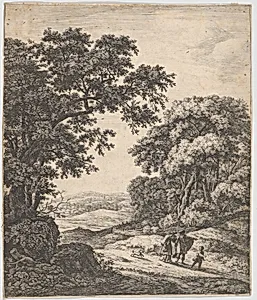
The Banishment of Hagar
17th century
Medium
Etching
Dimensions
sheet: 11 9/16 x 9 3/4 in. (29.4 x 24.7 cm)
Classification
Prints
Department
Drawings and Prints
Museum
Metropolitan Museum of Art, New York, NY
Credit
Bequest of Grace M. Pugh, 1985
Accession Number
1986.1180.1402
Rights
Public Domain
Tags
Art Historical Context
In the 17th etching *The Banishment ofagar*, Dutch artist Anthonie Waterloo a poignant biblical scene from Genesis 21. Here, Abraham sends away his concubine Hagar and their son Ishmael into the wilderness, accompanied by a dog—a subtle detail adding emotional depth and realism to the narrative of exile and survival. Waterloo, a master of landscape etching during the Dutch Golden Age, frames the human drama within a vast, atmospheric vista of rolling hills and sparse trees, emphasizing themes of isolation and divine providence. Etching, Waterloo's preferred medium, allowed for intricate lines and tonal effects through acid-bitten copper plates, making fine prints like this one (11 9/16 x 9 3/4 in.) accessible to collectors. This technique flourished in the Netherlands amid a booming print market, blending religious storytelling with innovative landscape artistry influenced by Rembrandt and the Haarlem school. Now in the Metropolitan Museum of Art's Drawings and Prints department, thanks to the 1985 bequest of Grace M. Pugh, the work exemplifies how 17th-century artists wove moral tales into evocative natural settings, inviting viewers to reflect on faith, family, and the human condition.
About the Artist
Anthonie Waterloo · 1609–1690
Anthonie Waterloo (1609–1690) was a prominent Dutch Golden Age landscape artist, born on May 6 in Lille, then part of the Spanish Netherlands. Little is known of his early life beyond his mother, Magdalena Vaillant, who joined Amsterdam's Walloon Church in 1621, with Waterloo following in 1630; no records exist of formal training, and he was likely self-taught. Registered as a painter in Amsterdam...