
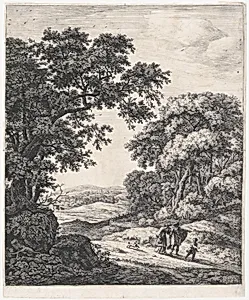
The Departure of Hagar
17th century
Medium
Etching
Dimensions
sheet: 11 5/8 x 10 1/16 in. (29.6 x 25.6 cm), thread margin on three sides.
Classification
Prints
Department
Drawings and Prints
Museum
Metropolitan Museum of Art, New York, NY
Credit
Gift of Kenneth Grebinar, 2005
Accession Number
2005.377.49
Rights
Public Domain
Tags
Art Historical Context
In the 17th-century etching *The Departure of Hagar*, Dutch artist Anthonie Waterloo a poignant biblical moment from the Book of Genesis. Hagar, the Egyptian servant cast out by Abraham and Sarah with her son Ishmael, is depicted amid a vast, atmospheric landscape. Waterloo, renowned for his intricate landscape prints, blends human figures with towering trees and expansive vistas, evoking themes of exile, hardship, and divine providence that resonated in the Dutch Golden Age. Etching, Waterloo's favored medium, allowed for delicate, expressive lines that mimic the textures of nature—rough bark, distant horizons, and subtle tonal gradations. This technique, perfected by Dutch masters like Rembrandt, made detailed landscapes accessible through prints, democratizing art for collectors across Europe. Measuring 11 5/8 x 10 1/16 inches, this sheet from the Metropolitan Museum of Art's Drawings and Prints department exemplifies Waterloo's mastery in composing serene yet narrative-driven scenes. A gift to the Met in 2005 from Kenneth Grebinar, *The Departure of Hagar* invites visitors to ponder the interplay of human drama and the sublime natural world, a hallmark of 17th-century Dutch art that continues to inspire reflection on faith and resilience.
About the Artist
Anthonie Waterloo · 1609–1690
Anthonie Waterloo (1609–1690) was a prominent Dutch Golden Age landscape artist, born on May 6 in Lille, then part of the Spanish Netherlands. Little is known of his early life beyond his mother, Magdalena Vaillant, who joined Amsterdam's Walloon Church in 1621, with Waterloo following in 1630; no records exist of formal training, and he was likely self-taught. Registered as a painter in Amsterdam...