
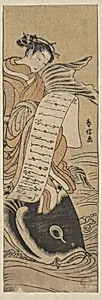
The Bijin Kinko
ca. 1766
Medium
Woodblock print; ink and color on paper
Dimensions
H. 8 3/16 in. (20.8 cm); W. 2 3/4 in. (7 cm)
Classification
Prints
Culture & Period
Japan · Edo period (1615–1868)
Department
Asian Art
Museum
Metropolitan Museum of Art, New York, NY
Credit
Gift of Estate of Samuel Isham, 1914
Accession Number
JP864
Rights
Public Domain
Tags
Art Historical Context
Suzuki Harunobu's *The Bijin Kinko* (ca. 1766) is a delicate woodblock print from Japan's Edo period (16151868), capturing the essence of ukiyo-e, the "pictures of the world" that celebrated fleeting pleasures like beauty and leisure Harunobu, a pioneering artist, revolutionized printmaking around this time by full-color nishiki-ebrocade pictures), layering vibrant inks to achieve unprecedented depth and realism paper. This intimate work, measuring just 8 3/16 2 3/4 inches, exemplifies the narrow *hashira-e* format, designed for hanging on pillars in homes. The title, translating to "Beauty with a Fishhook," depicts an elegant woman—likely a *bijin* or idealized beauty—engaged in reading while handling a fishhook, blending serene domesticity with subtle playfulness. Tags highlight women, fish, and reading, evoking everyday Edo life amid urban pleasures. Harunobu's mastery shines in his fine lines, subtle gradations (*bokashi*), and glowing colors, which brought ukiyo-e to new artistic heights. Housed in the Metropolitan Museum of Art's Asian Art Department, this print reflects the period's cultural boom in affordable art for the rising merchant class, making high art accessible and influencing global aesthetics. A gem for visitors, it invites contemplation of beauty's quiet moments.
About the Artist
Suzuki Harunobu · 1725–1770
Suzuki Harunobu (c. 1725-1770) was a Japanese ukiyo-e artist who revolutionized woodblock printing by developing nishiki-e—full-color prints using multiple woodblocks—in 1765. Before Harunobu, Japanese prints were limited to two or three colors; his innovation unleashed the entire artist's palette, transforming ukiyo-e into the vibrant art form that would later captivate Western artists from Manet...