
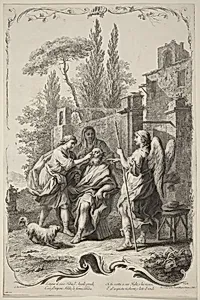
The Blind Tobias
Medium
etching and engraving on laid paper
Dimensions
sheet (trimmed to plate mark): 52 x 34.6 cm (20 1/2 x 13 5/8 in.)
Classification
Department
CG-E
Museum
National Gallery of Art, Washington, D.C.
Credit
Ailsa Mellon Bruce Fund
Accession Number
1984.84.11
Rights
Public Domain
Art Historical Context
Behold *The Blind Tobias*, a captivating 18th-century print by Joseph Wagner after a design by the Italian artist Giuseppe Zocchi, circa 1745. This work draws from the biblical Book of Tobit, depicting the moment of Tobias's blindness—a poignant scene of vulnerability and faith that resonated in Baroque and Rococo religious art. Zocchi, known his elegant Florentine scenes and historical subjects, provided the original composition, while Wagner, a prominent Venetian engraver and publisher, faithfully reproduced it, making fine art accessible to a wider audience during the Enlightenment era. Crafted as an etching and engraving on laid paper—a handmade sheet with distinctive chain lines visible under light—the print measures 52 x 34.6 cm. Etching allowed for fluid, expressive lines via acid-bitten plates, while engraving added precise, intricate details with a burin tool, showcasing the technical virtuosity of 18th-century intaglio printmaking. These mixed techniques captured subtle textures and emotional depth, ideal for narrative subjects like this. Housed in the National Gallery of Art's collection through the Ailsa Mellon Bruce Fund, *The Blind Tobias* exemplifies how prints bridged elite painting and popular devotion, preserving Zocchi's vision for generations of admirers. A testament to collaborative artistry, it invites us to ponder themes of healing and divine providence.