
The Boy with the Arrow
1903
Medium
Painting
Classification
Painting
Department
Smithsonian Collection
Museum
Smithsonian American Art Museum
Credit
Smithsonian American Art Museum, Gift of William T. Evans
Accession Number
1909.7.68
Rights
Public Domain
Tags
About this artwork
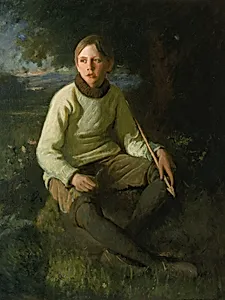
Douglas Volk’s son, Leo, sits in a lush field at twilight, catching his breath from a day's excitement outdoors. He holds the arrow in a relaxed grip, as a confident young hunter would carry his spear. Leo occupies a transitional time in life, no longer a boy and not yet a man. In the early twentieth century the term "adolescence" came into popular use, and psychologists encouraged parents to guide their children through these turbulent years (Mintz, Huck's Raft: A History of American Childhood,...
Art Historical Context
Douglas Volk’s “The Boy with the Arrow,” painted in 1903, portrays the artist’s son Leo seated in a lush field at twilight. The boy grips an arrow with easy confidence of a young hunter, embodying the threshold between childhood and adulthood. Volk presents his energetic American son in a serene, pastoral landscape that evokes both contemporary life and classical ideals of youth. The work appeared at a moment when the term “adolescence” was gaining currency, and psychologists urged parents to guide children through these formative years. Just a year earlier, the character Peter Pan had debuted in Scribner’s Magazine, capturing society’s fascination with eternal boyhood. Volk’s painting resonated with these cultural currents, earning acclaim when shown at the 1904 St. Louis World’s Fair. Now part of the Smithsonian American Art Museum collection, the canvas invites viewers to consider the timeless tension between youthful freedom and the approach of maturity. Its warm twilight setting and relaxed figure continue to speak to audiences about the brief, luminous passage of youth.